What's Really Behind "The Race To The Top"
Teach-in on the Privatization of Public
Education and a consciousness raising
bake sale for public education!
●Who's directing national
education policy?
●Should states have to
compete for limited federal
funding in order to save their
public schools?
●How do standardized testing
and school choice affect our
public education?
●When did accountability
mean punishment of
teachers?
Date: Saturday, March 27, 11am-2pm
Location: Intersection of 8th and Market St, downtown
Sponsored by: Literacy for Social Justice Teacher
Research Group and public school
teachers
bake sale for public education!
Find out what you can do to join the struggle to
defend public education!
Wednesday, March 24, 2010

Education and the Media: Inquiry to Action
Education and the Media: Inquiry to Action
Saturday, April 10, 2010
Panel Discussion with Members of the Media
10 – 12 AM
Plus 3 more follow-up sessions
April 24th, May 8th, and May 22nd
Julia Davis Branch
St. Louis Public Libraries
St. Louis MO 63106
All ages and people welcome – young people, students, teachers, community members, artists, grandparents!
About the Session:
The media creates certain narratives about education, and those narratives influence the everyday understandings of educational concepts such as: school choice, the achievement gap, equity, and funding. In this ItAG we will examine the complex and multilayered ways in which education is represented and shaped by the media and, in turn, how people experience and understand education. We will kick off with a panel discussion by members of the St. Louis media – representing the Internet, TV, radio, and print – as we examine the ways that education is presented.
About the Facilitator:
Marilyn Ayres-Salamon has had a rich range of experiences as a public school teacher in both a suburban and urban district; in an alternative school for students with emotional and behavior disabilities, and an instructor at the university level. She has national certification through the Journalism Educators Association. She is presently on the Educational Studies faculty at Saint Louis University.
This four-session Inquiry to Action Group is offered FREE by the Literacy for Social Justice Group with the support of the Doerr Center for Social Justice at SLU. It is part of a larger project called
“Public Education, Public Voices.”
To register, contact Kathryn Pole at 314 977-7107 or email kpole@slu.edu by April 8th.
Saturday, April 10, 2010
Panel Discussion with Members of the Media
10 – 12 AM
Plus 3 more follow-up sessions
April 24th, May 8th, and May 22nd
Julia Davis Branch
St. Louis Public Libraries
St. Louis MO 63106
All ages and people welcome – young people, students, teachers, community members, artists, grandparents!
About the Session:
The media creates certain narratives about education, and those narratives influence the everyday understandings of educational concepts such as: school choice, the achievement gap, equity, and funding. In this ItAG we will examine the complex and multilayered ways in which education is represented and shaped by the media and, in turn, how people experience and understand education. We will kick off with a panel discussion by members of the St. Louis media – representing the Internet, TV, radio, and print – as we examine the ways that education is presented.
About the Facilitator:
Marilyn Ayres-Salamon has had a rich range of experiences as a public school teacher in both a suburban and urban district; in an alternative school for students with emotional and behavior disabilities, and an instructor at the university level. She has national certification through the Journalism Educators Association. She is presently on the Educational Studies faculty at Saint Louis University.
This four-session Inquiry to Action Group is offered FREE by the Literacy for Social Justice Group with the support of the Doerr Center for Social Justice at SLU. It is part of a larger project called
“Public Education, Public Voices.”
To register, contact Kathryn Pole at 314 977-7107 or email kpole@slu.edu by April 8th.
Tuesday, March 9, 2010
Blogging from the WE LEARN Conference
A group of attendees is blogging about the workshops as the WE LEARN conference this weekend. I think some of you might find the discussions interesting. Some of the topics include: Choosing Books that Change Our Lives, Student Leadership, and Women's Literacy and Social Justice. Learn more by visiting the blog here.
Tuesday, February 23, 2010
Building Together: Art, Education and Democracy
Building Together: Art, Education and Democracy
Sunday, March 21, 2010
1 – 3 PM
Plus 3 more biweekly sessions -
schedule to be determined by participants
1627 N. 19th St (upstairs)
St. Louis MO 63106
(on the corner of 19th and Madison)
All ages and people welcome – young people, students, teachers, community members, artists, grandparents!
A test-driven curriculum pushed the arts to the margins of our schools. Arts based projects at the forefront of our educational planning secure a strong future for our students. In this Inquiry to Action Group (ItAG) – Art, Education and Democracy – we will collaborate to create art in order to take a deeper look at our personal and community environment, a key part of social growth and understanding. Dail Chambers, teaching artist, will guide participants as they work together to create free-standing sculptures and participate in discussions focused on: art's role in historical social movements; multicultural arts; contemporary art activism and arts based collaboration in classroom activity.
Through our inquiry, creation and action, participants will find ways to transfer basic art techniques & processes learned into their work as citizens, parents and educators. No previous art experience is needed. Participants are asked to bring one small to midsized item that is attached to an experience, place or memory. The requested item will not be used in making of artwork. People should commit to attending 4 sessions.
About the Facilitator :
Dail Chambers is a community based, teaching artist. She studied photography at St. Louis Community College Florissant Valley and received her BFA from Memphis College of Art in Clay, with a minor in Art History. Chambers’s artwork is centered around african art, women's issues and social constructs. Most recently she has completed her Community Arts Training Institute fellowship. Chambers has curated numerous exhibitions, and founded the AIDS Project in Memphis TN. She is currently collaborating with National artist Carl Moore. Both artists will share the topic of "Moving Back: Our experiences living in the American "South," generations after the Great Migration. The exhibition is to be held in St. Louis at the Vaughn Cultural Center, January 2011. Her two Spring 2010 shows include From the Center Now!, a national exhibition juried by Lucy Lippard, held in Chicago Ill; and Art as Activism juried by Yolanda Lopez, held in St. Charles, MO.
This four-session Inquiry to Action Group is offered FREE by the Literacy for Social Justice Group with the support of the Doerr Center for Social Justice. It is part of a larger project called “Public Education, Public Voices.” To register, contact Kathryn Pole at 314 977-7107 or email kpole@slu.edu by March 15th.
Sunday, March 21, 2010
1 – 3 PM
Plus 3 more biweekly sessions -
schedule to be determined by participants
1627 N. 19th St (upstairs)
St. Louis MO 63106
(on the corner of 19th and Madison)
All ages and people welcome – young people, students, teachers, community members, artists, grandparents!
A test-driven curriculum pushed the arts to the margins of our schools. Arts based projects at the forefront of our educational planning secure a strong future for our students. In this Inquiry to Action Group (ItAG) – Art, Education and Democracy – we will collaborate to create art in order to take a deeper look at our personal and community environment, a key part of social growth and understanding. Dail Chambers, teaching artist, will guide participants as they work together to create free-standing sculptures and participate in discussions focused on: art's role in historical social movements; multicultural arts; contemporary art activism and arts based collaboration in classroom activity.
Through our inquiry, creation and action, participants will find ways to transfer basic art techniques & processes learned into their work as citizens, parents and educators. No previous art experience is needed. Participants are asked to bring one small to midsized item that is attached to an experience, place or memory. The requested item will not be used in making of artwork. People should commit to attending 4 sessions.
About the Facilitator :
Dail Chambers is a community based, teaching artist. She studied photography at St. Louis Community College Florissant Valley and received her BFA from Memphis College of Art in Clay, with a minor in Art History. Chambers’s artwork is centered around african art, women's issues and social constructs. Most recently she has completed her Community Arts Training Institute fellowship. Chambers has curated numerous exhibitions, and founded the AIDS Project in Memphis TN. She is currently collaborating with National artist Carl Moore. Both artists will share the topic of "Moving Back: Our experiences living in the American "South," generations after the Great Migration. The exhibition is to be held in St. Louis at the Vaughn Cultural Center, January 2011. Her two Spring 2010 shows include From the Center Now!, a national exhibition juried by Lucy Lippard, held in Chicago Ill; and Art as Activism juried by Yolanda Lopez, held in St. Charles, MO.
This four-session Inquiry to Action Group is offered FREE by the Literacy for Social Justice Group with the support of the Doerr Center for Social Justice. It is part of a larger project called “Public Education, Public Voices.” To register, contact Kathryn Pole at 314 977-7107 or email kpole@slu.edu by March 15th.
Tuesday, October 13, 2009
Voices Silenced and Voices Mandated In the Classroom
Unlock the Power of Literacy:
It’s Your Civil HUMAN Right
The momentum continues…
Join us as we turn the page from our year long series of forums and events focused on banned books to a new chapter as we kick-off a year dedicated to . . .
Voices Silenced and Voices Mandated in the Classroom
October 20, 2009
1– 3 p.m.
Legacy Books and Café
5249 Delmar Blvd.
St. Louis, MO 63108
Bring your favorite banned book and join us for light refreshments and announcements of upcoming events as we continue to
UNLOCK the POWER of LITERACY!
It’s Your Civil HUMAN Right
The momentum continues…
Join us as we turn the page from our year long series of forums and events focused on banned books to a new chapter as we kick-off a year dedicated to . . .
Voices Silenced and Voices Mandated in the Classroom
October 20, 2009
1– 3 p.m.
Legacy Books and Café
5249 Delmar Blvd.
St. Louis, MO 63108
Bring your favorite banned book and join us for light refreshments and announcements of upcoming events as we continue to
UNLOCK the POWER of LITERACY!
Thursday, September 10, 2009
Reading Banned Books
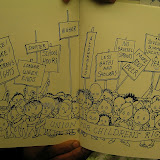
These photos were taken in Adult Education classrooms as part of the Reading Banned Books bookclub project (described a few posts back). Click on the photo below to view the album.
 |
| Media Lab |
Tuesday, September 8, 2009
5th Annual Educating for Change Curriculum Fair “Reclaiming Education as a Civil Right”
 Version:1.0 StartHTML:0000000149 EndHTML:0000002734 StartFragment:0000000199 EndFragment:0000002700 StartSelection:0000000199 EndSelection:0000002700
 You are Invited to....
5th Annual Educating for Change Curriculum Fair
“Reclaiming Education as a Civil Right”
Saturday, September 26th from 9 am to 3 pm
University of Missouri-St. Louis, South Campus
Marillac Hall
8001 Natural Bridge Rd.
St. Louis, MO 63121 (next to South Campus Metro Station)
Free Parking and Lunch
Flyer attached for distribution.
Join us for a day filled with...
Resource Tables from local organizations committed to social justice.
Poster Presentations by educators including findings of teacher-research, lesson plans, books, videos, resources, curricular guides and inspirational ideas for teaching.
Hands on and interactive workshop sessions with educators and activists on themes such as: the school-to-prison pipeline, bilingual education, understanding institutionalized poverty, using art and movement to enhance learning, designing culturally diverse curriculum.
Featured Speaker:
JILL FRIEDBERG is a Seattle-based filmmaker, editor and community radio producer who founded Corrugated Films. Jill's work focuses on education, media and social change. Her films "Granito de Arena" and "Un Poquito de Tanta Verdad" document how teachers sparked a resistance movement against neoliberal education policies that aim to dismantle public education.
Cost: $10 suggested donation
Lunch will be provided.
Sponsored by:
The Literacy for Social Justice Teachers Research Group; Dean’s Committee on Social Justice in the College of Education, UMSL; Literacy Roundtable; The Justice Institute; Women's Voices Raised
For more information contact: Kathryn Pole 314-977-7107 or kpole@slu.edu
Subscribe to:
Posts (Atom)